
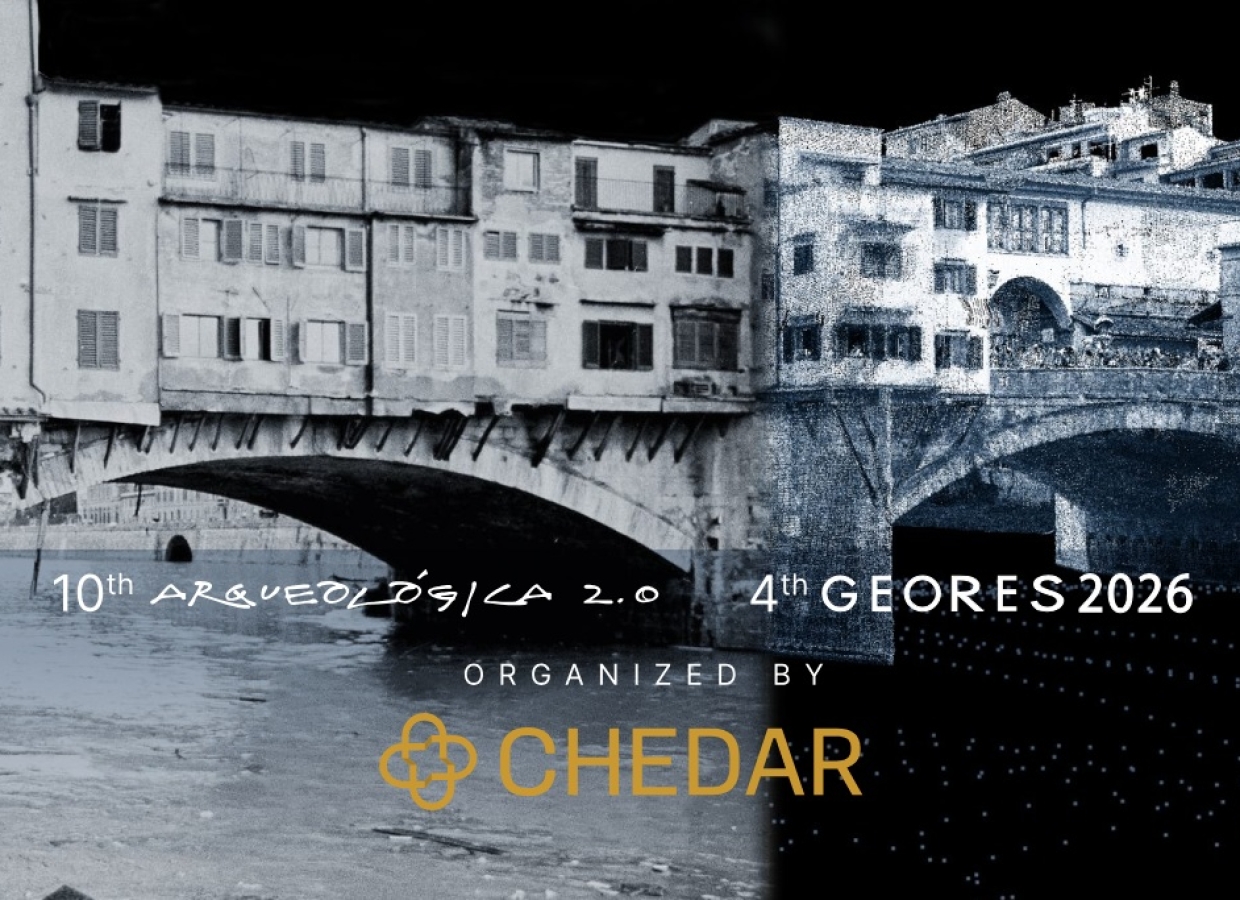
Two international conferences return together in a renewed framework focusing on AI, digital twins, and heritage resilience. In 2026, discussing cultural heritage, both tangible and intangible, means facing an unprecedented transformation.
Artificial intelligence, digital twins, cloud platforms, and FAIR (Findable, Accessible, Interoperable, Reusable) data infrastructures are redefining methods and responsibilities in the documentation, interpretation, and preservation of heritage, in line with new agendas on sustainability, risk management, and responsible innovation.
This is the backdrop for Digital Ecosystems for Heritage 4.0, the international symposium to be held in Florence from August 26 to 28, 2026, organized by the CHEDAR – Cultural Heritage Digitalization and Resilience project with the support of ICOMOS Italia (International Council on Monuments and Sites) and CIPA-Heritage Documentation (ICOMOS International Scientific Committee). The initiative reunites GEORES – Geomatics and Restoration and Arqueológica 2.0, historically independent international conferences previously held jointly in Valencia in 2021. The 2026 edition not only reiterates that model, but also relaunches it within a broader perspective, reflecting a strategic path dedicated to the development of a sustainable and responsible digital ecosystem for heritage.
Save the Dates
-
February 20, 2026: Submission of extended abstracts
-
April 15, 2026: Notification of revisions
-
May 31, 2026: Submission of final versions of papers (camera-ready)
A new phase for a proven partnership
If 2021 represented an initial meeting point between the geomatics and archaeological communities, 2026 introduces a different scale of ambition. The collaboration is anchored in the CHEDAR project and is configured as a space for co-design between research, governance, policy, education, and museums. The symposium aims to develop guidelines, shared criteria, and operational perspectives, with the aim of outlining a roadmap towards a coherent, transparent, and sustainable Heritage 4.0 ecosystem.
The role of CHEDAR and the Heritage 4.0 vision
The symposium is based on the vision of the CHEDAR Research Center, conceived as a technological and cultural hub dedicated to the study, documentation, and protection of heritage at risk in the Mediterranean, particularly in contexts exposed to conflict, climate change, and the degradation of territorial systems. The center integrates digital innovation, humanistic and scientific skills, artistic experimentation, and advanced training, with the aim of designing an ethical, inclusive, and community-oriented Heritage 4.0, in line with the most recent European heritage frameworks.
The concept of a Digital Ecosystem proposed by the symposium goes beyond the idea of digitalization as a one-off operation. Heritage is understood as a dynamic relational system, in which data, models, sensors, and immersive platforms are activated to generate cultural, operational, and social value. In this context, Digital Twins are not simple three-dimensional models, but evolving and updatable systems capable of simulating risk scenarios, supporting decision-making processes, and enabling new forms of access and mediation.
This perspective raises key questions: how can we ensure the traceability and verifiability of digital processes? How can we integrate automation into professional workflows? What responsibilities and new skills are required to manage data-driven predictive and operational models in asset management?
Symposium Thematic Structure
The program is divided into five main areas of work.
-
AI, Governance, and Critical Futures of Cultural Heritage. Trust, Bias, Digital Rights, and Responsibility in Artificial Intelligence Systems.
-
Digital Twins and Computational Realities. Interoperability, Sustainability, Versioning, Limits, and Extension of Digital Modeling Beyond 3D.
-
Heritage Under Pressure: Risk, Monitoring, and Resilience Strategies. Digital Diagnostics, Early Warning, and Management of Natural and Man-Made Risks.
-
Museums After Digital: Accessibility, Hybrid Experiences, and New Audiences. Post-digital museums, XR environments, multisensory narratives, and visitor rights.
-
Skills for Heritage 4.0: Training, New Professions, and Knowledge Transmission. Emerging Profiles, Interdisciplinary Training, and Capacity Building for the Professions of the Future.
The CHEDAR Project after Osaka: Prospects and Future Paths
The symposium is part of the CHEDAR project, launched as an initiative of the Expo 2020 Dubai Legacy program and presented internationally at Expo 2025 Osaka. The Japanese experience represented a turning point: not only a showcase of technical results, but also a phase of listening and discussion with institutions, research centers, and global stakeholders. Several guidelines emerge from Osaka that outline the project's future development. First, the need to consolidate interoperability models between data, platforms, and formats, with direct implications for the definition of shared standards. Second, the interest in certification and verifiability protocols for digital processes, necessary for integrating Digital Twins and predictive systems into the operational flows of curators, administrations, and museum operators. Finally, the openness to forms of transnational cooperation in the Mediterranean area, both for the sharing of common methodologies and for the coordinated management of heritage sites threatened by climate or geopolitical risks.
Looking beyond 2026, CHEDAR is a cultural infrastructure designed to produce effects beyond the project's lifespan, with three potential priority outcomes: the creation of a permanent observatory on digital heritage, intended as a place for collecting and analyzing data generated by digital ecosystems; the definition of an advanced training platform, open to professionals and institutions, dedicated to continuous skills development; and the progressive construction of a European and Mediterranean network of pilot museums and institutions, aimed at experimenting with immersive museum models and integrated management of Digital Twins. From this perspective, Digital Ecosystems for Heritage 4.0 represents not only a moment of synthesis, but the launch of a process of collective maturation towards a new culture of heritage in the age of artificial intelligence.
Conclusions
2026 represents an evolutionary transition for the sector: Florence is emerging as a platform for convergence between disciplines, institutions, and technologies, ushering in a phase in which heritage is not simply digitized, but inhabits a digital ecosystem capable of impacting conservation, management, and enjoyment. GEORES and Arqueológica 2.0 are returning together not as a simple joint event, but as a constituent part of a vision that aims to build a culture of data and digital responsibility in heritage.
In this sense, Digital Ecosystems for Heritage 4.0 takes on the value of a cultural infrastructure even more than a conference: a place of discussion and construction, where research, practice, and governance contribute to defining the future of cultural heritage in the age of artificial intelligence.
Expo Osaka represents a strategic milestone for CHEDAR, which will continue its journey through Expo 2030 Riyadh, consolidating the idea of a Universal Exposition in a permanent and comprehensive format for the first time.
More informations at:
https://chedarproject.org/
https://digitalecosystems4h.org/
