
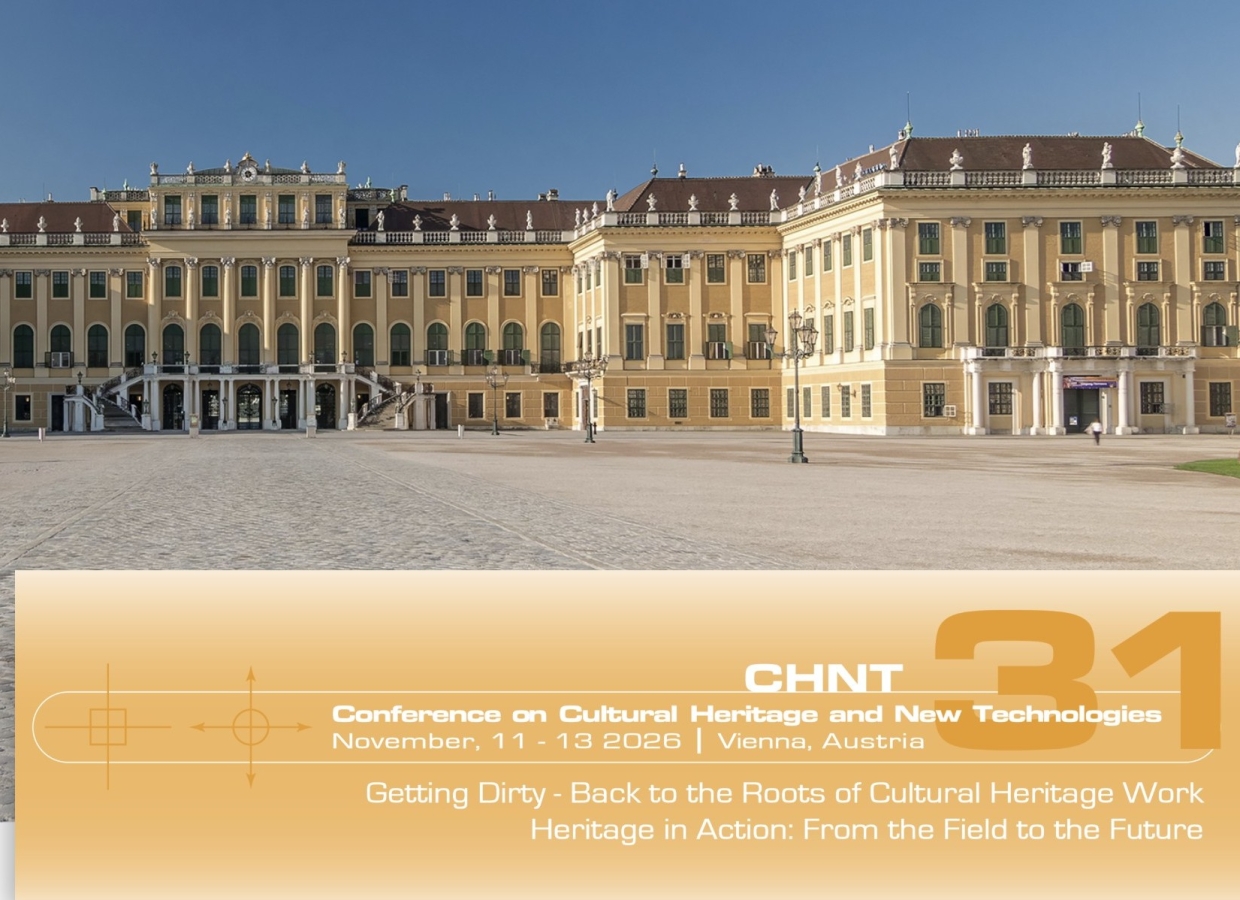
Cultural heritage is best understood in its original context: in the field, within historic structures, and across human-shaped landscapes. Archaeological and architectural research provides the foundation for interpreting these environments, while World Heritage frameworks guide the long-term protection, management, and communication of both tangible and intangible values.
Digital technologies—used for surveying, documentation, analysis, or interpretation—are essential across heritage work. Their full potential, however, is revealed only in real operational conditions, where dust, weather, decay, human presence, and logistical constraints affect every decision. It is in this dynamic space—where research, management, and communication intersect—that contemporary heritage practice truly takes shape.
CHNT31 brings these dimensions together by returning to the core of cultural heritage work
The conference examines how digital methods function in the field, how various research domains inform management strategies, how World Heritage understanding evolves, and how the values of heritage are communicated to diverse audiences. Aligned with UNESCO’s mission, CHNT31 also addresses human experience, participation, and ethical considerations—key factors shaping how heritage is perceived, engaged with, and transmitted to future generations.
CHNT31 considers all actors in the heritage field: researchers, digital specialists, practitioners, managers, and those who combine multiple roles. Upholding the 30-year tradition of CHNT, the conference strengthens the dialogue in which developing, testing, and refining digital methods goes hand in hand with their application in protecting, interpreting, and sustaining cultural heritage. Research responds to practical needs, and real-world challenges inspire new directions.
The conference invites researchers, practitioners, site managers, policymakers, students, and community representatives to reflect together on shared responsibilities and opportunities where scientific knowledge, digital innovation, and management practice intersect.
Practical Realities of On-Site Heritage Work
- Archaeological excavations and surveys
- Architectural heritage investigations and diagnostics
- Building archaeology in active construction environments
- Emergency and rapid documentation missions
- Outdoor digital recording (photogrammetry, laser scanning, drone mapping)
- Data resilience in uncontrolled environments (weather, dust, access constraints)
- Raising awareness for endangered heritage under extreme conditions (conflicts, climate change)
- Developing pragmatic and creative solutions under limited time and budget while ensuring high-quality documentation
Archaeology & World Heritage: Complementary Approaches
- How archaeological findings shape management decisions
- Understanding authenticity and integrity through fieldwork
- Monitoring and mission-based documentation
- Cultural landscapes, historic gardens, and living heritage management
- Integrating research into planning, conservation, and risk preparedness
Interpretation, Storytelling & Community Engagement
- Immersive and location-based interpretation (AR, VR, outdoor applications)
- Community-informed narratives and participatory approaches
- Communicating archaeological results accessibly
- Digital tools for inclusive storytelling (youth perspectives, local voices)
- Heritage as identity: engaging diverse audiences meaningfully
Ethics, Data Governance & Responsible Innovation
- Ownership, stewardship, and control of digital data
- Digital repatriation, especially in archaeology
- Transparency, bias, and accountability in AI and automated workflows
- Ethical storytelling and handling sensitive content
- Long-term care, accessibility, and sustainability of digital archives
Big Data, AI & Synthetic Knowledge Creation
- Managing large-scale excavation archives and synthesizing results
- Reconciling heterogeneous data quality across contributors
- Biodiversity and sensor data from historic gardens and landscapes
- 3D models and architectural documentation as cumulative resources
- Cross-site comparative analyses and regional/national synthesis
- Machine learning for classification, prediction, pattern recognition, even under limited infrastructure
- Data storage, transfer, and processing constraints in the field
- Focusing on data interpretation to generate knowledge rather than merely collecting
Education, Capacity Building & Young Professionals
- Field schools and university expeditions
- Training the next generation of heritage professionals
- Student laboratories and project-based learning
- Skill-building workshops (photogrammetry, XR storytelling, ethical data handling)
Here you can submit your proposal
More information at: www.chnt.at