All Stories

Inside the Belt and Road - China and Italy

The Silk Road, originated in ancient China’s Western Han period (202 B.C – A.D 8), started from Chang’an (now Xi’an) and connected many countries in Asia, Europe, and Africa, and finally arrived in ancient Rome. The Silk Road’s initial role was to transport China’s silk, porcelain, and other products to the other countries, but it gradually plays a role in the cultural, political, and economic communications between different countries. On March 23, 2019, Italy signed China’s New Silk Road project. Through thousands of years’ communication, China and Italy have built strong ties over various facets. Archaeology is one of the closest bonds. The archaeological and cultural cooperation between Italy and China have created innovative and surprising breakthroughs. 

Inside the Belt and Road - China and Italy

Cultural Heritage’s Conservation and Innovation in a Globalized World

The existence of cultural heritage not only shows the history, culture, and society from the past era to the present time and people, but it also plays a role on continuing the past spirit, strength, and thought through the modern world. The cultural heritage, both material and nonmaterial, is accompanied by our ancestors’ minds and transmit them to us across the border of the time. To value and preserve them more, experts from different countries cooperate and share their own knowledge with each other. 

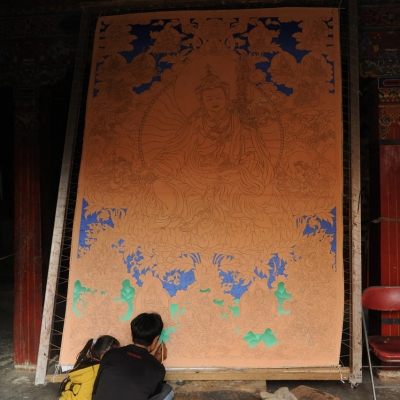
A Changzhu Temple in China's Shannan, photographed by Cha qun

Advanced VR, iMmersive serious games and Augmented REality as tools to raise awareness and access to European underwater CULTURal heritagE - Baia Italy

Project’s i-MareCulture scope is to raise public awareness of European identity by focusing in maritime cultural heritage, which by default bridges different civilizations. In particular, i-MareCulture aims in bringing inherently unreachable underwater cultural heritage within digital reach of the wide public by implementing virtual visits, serious games with immersive technologies and underwater augmented reality.

imareculture

Analog/digital image processing of historical aerial imagery in the Italian National Photographic Aerial Archive (AFN-ICCD)

3 - 4 June 2019 (IGN headquarters | 73, Avenue de Paris, 94165 Saint-Mandé, France) . More and more countries have digitized or are currently digitizing their archives of aerial images. They are a unique and relatively unexplored means to chronicle land-cover information over the past 100 years with very high spatial resolution. Such data provide a relatively dense temporal sampling of the territories. 3D information can even be retrieved since many surveys were performed under photogrammetric conditions. Therefore, both long-term environmental monitoring studies and historical object detection can be based on the analysis of these very rich time series of images.

Analog/digital image processing of historical aerial imagery in the Italian National Photographic Aerial Archive (AFN-ICCD)

How Brindisi, Italy is using GIS to help preserve its ancient architecture

One of the most fascinating applications of geographic information systems (GIS) is when it’s used within a deeply historic landscape. Knowing that advanced GIS software lies behind the preservation and protection of a rich cultural environment is, for a GIS professional, incredibly fulfilling. This innovative location technology solution is responsible for preserving the heritage of some of the world’s most significant sites, and the town of Brindisi is no exception. This perfect alignment of old with new, past with present and physical with digital is GIS at its best.

How Brindisi, Italy is using GIS to help preserve its ancient architecture

Cultural Heritage: challenges, new perspectives and technology innovation Towards informative content models and beyond

Politecnico di Milano, in conjunction with Università degli Studi Firenze (UNIFI) and Politecnico di Torino (POLITO), is organizing the 2nd International Conference GEORES 2019 on “Cultural Heritage: challenges, new perspectives and technology innovation Towards informative content models and beyond” (ISPRS and ICOMOS CIPA event).

Cultural Heritage: challenges, new perspectives and technology innovation Towards informative content models and beyond

HeriTech 2020 the Future of Heritage Science and Technologies

Florence Heri-Tech was born in 2018 from an idea of the DIEF, Department of Industrial Engineering of University of Florence and Florence Biennal Art and Restoration Fair The idea was to create a synergy between Cultural Heritage and New Technologies. The idea was create a synergy between business world and university world.

HeriTech 2020 the Future of Heritage Science and Technologies