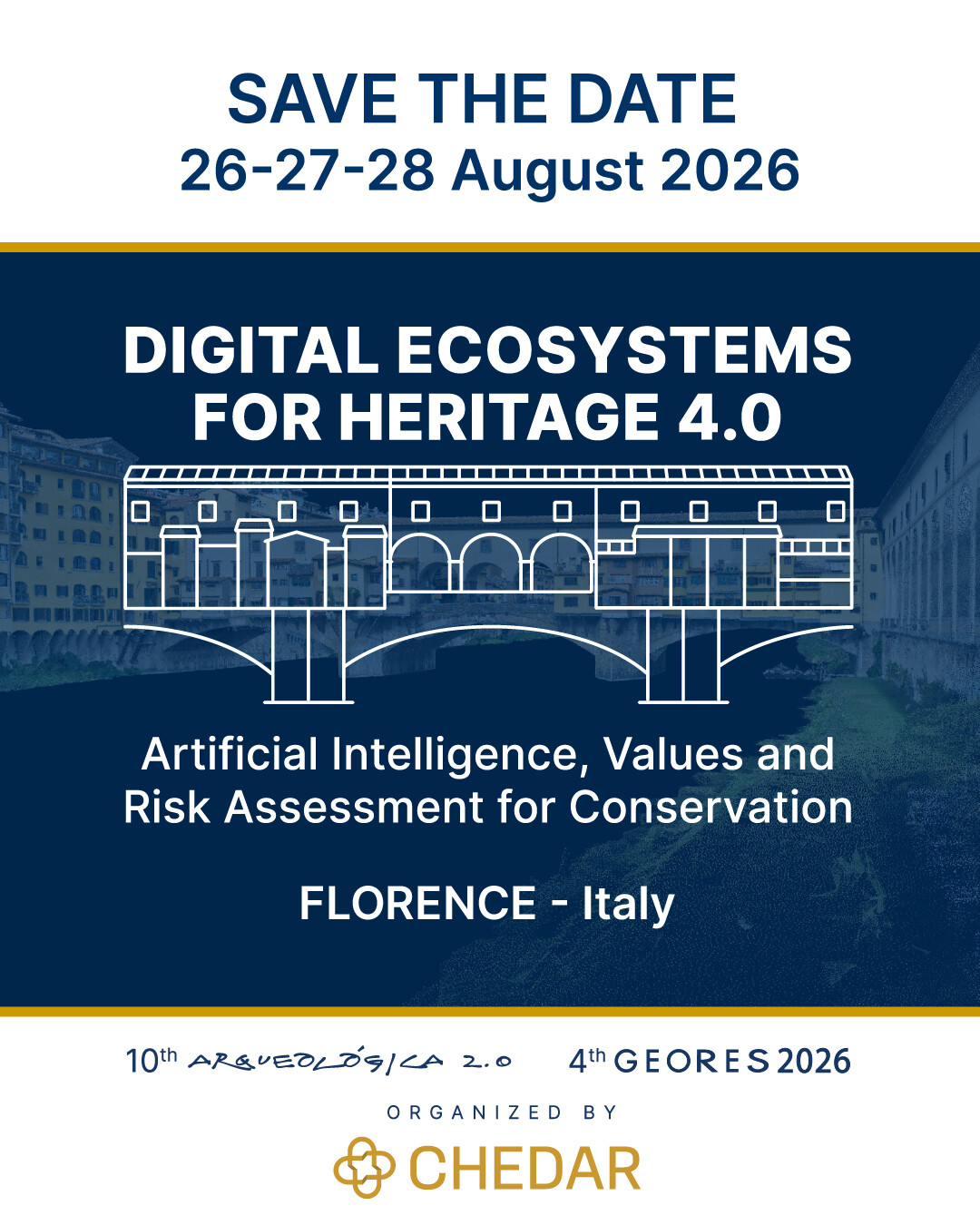
In 2026, speaking about cultural heritage, tangible and intangible, means engaging with a profound transformation. Artificial Intelligence (AI), Digital Twins, cloud platforms and FAIR (Findable, Accessible, Interoperable, Reusable) data infrastructures are reshaping the ways we document, interpret and protect heritage, aligning with emerging agendas on sustainability, risk management and responsible innovation.
The joint 4th GEORES and 10th Arqueológica 2.0 Symposium, organized by CHEDAR (Cultural Heritage Digitalization and Resilience) project and supported by ICOMOS Italia(International Council on Monuments and Sites), and CIPA-Heritage Documentation (ICOMOS International Scientific Committee), positions itself as a strategic laboratory: three days to outline a shared roadmap toward a coherent and sustainable digital ecosystem for heritage, integrating research, advanced training and long-term policy. In line with CHEDAR’s mission, focused on 3D digitization, Digital Twins, AI and eXtended Reality for risk management, the Symposium invites participants to conceive Cultural Heritage as a dynamic relational system rather than a static collection of objects.
TRACK 1
Museums After Digital: Accessibility, Hybrid Experiences and New Audiences
How will Museums of the Future rethink access, experience and mediation?
A forward-looking track addressing what museums will become in the next decade.
Topics include but are not limited to:
- Immersive XR and hybrid physical–digital environments;
- New forms of accessibility: sensory, cognitive, remote and social inclusion;
- Computational storytelling and multisensory narratives;
- Ethical issues in digital museums: privacy and digital visitor rights;
- Participatory and community-driven digital engagement.
TRACK 2
- Digital workflows for heritage conservation;
- From integrated surveying to living, interoperable Digital Twins;
- Digital Twins for management, monitoring and decision-making;
- Data traceability, versioning and reuse in 3D ecosystems;
- AI-enhanced modelling, sensor integration and predictive platforms;
- Costs, limitations and sustainability of Digital Twins in heritage.
TRACK 3